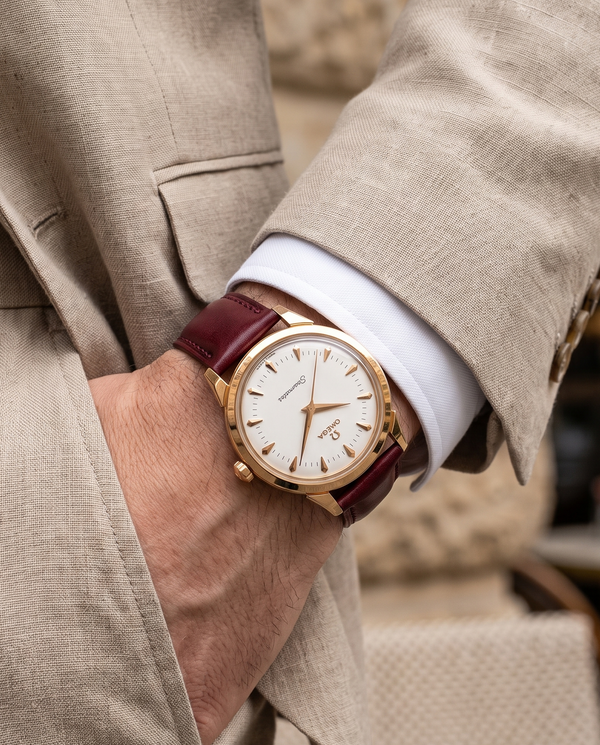
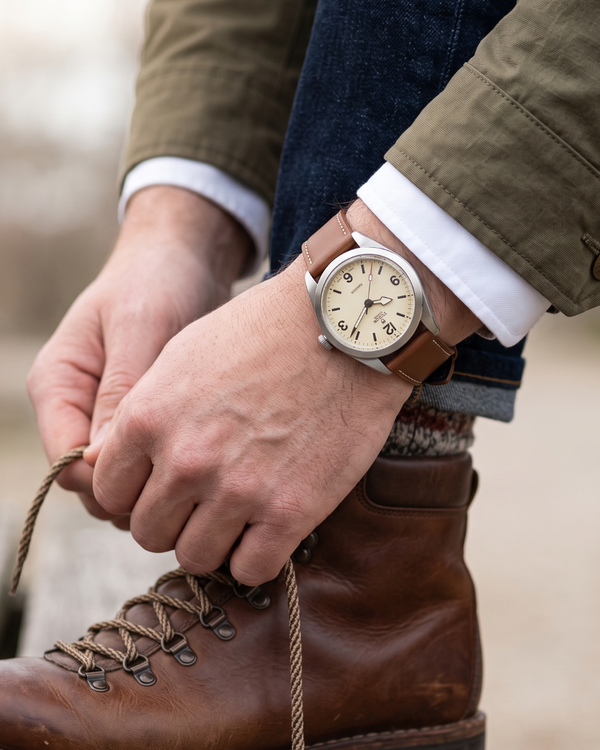
Check the material grade, the edges, the stitching, the lining, the hardware and the fit. A good strap has a clearly named leather grade, smooth even edges, neat tight stitches, a soft natural lining, solid stainless steel hardware and exact sizing. Most of these can be judged in a minute, in hand or from close-up photos.
Key facts
- Edges and lining reveal quality faster than the face of the strap.
- A vague material description ("PU", "genuine leather") is a warning sign.
- Hardware should be stainless steel, not plated base metal.
- Precise width and taper matter as much as material.
The 10-point check
- Named material. The maker should say exactly what it is: full-grain calf, goat suede, FKM rubber. Vague terms usually hide a lower grade.
- Edges. Run a fingernail along the edge. It should be smooth and sealed, with no fraying, gaps between layers or blobs of paint.
- Stitching. Stitches should be even in length, straight, tight and close to the edge, with no loose ends at the keeper or buckle end.
- Lining. Turn it over. A good lining is real leather, soft, smooth and neatly finished. Plastic-feel or rough linings trap sweat and wear out first.
- Layer bonding. Bend the strap gently. Layers should move as one, without bubbles, gaps or separation at the ends.
- Holes. Clean, evenly spaced, with smooth walls. Torn or fibrous holes stretch quickly.
- Keepers. Firm, well stitched or fused, and snug enough to hold the tail. Many good straps have one fixed and one floating keeper.
- Hardware. The buckle should feel solid and be stainless steel, with clean polishing and no sharp edges. Spring bars or quick-release pins should snap firmly.
- Sizing accuracy. Width at the lugs should be the exact stated size, with a sensible taper and a length that suits your wrist.
- Smell and feel. Good leather smells natural and feels supple. A strong chemical smell or a plasticky surface suggests heavy coating.
Red flags in product listings
| You see | It may mean |
|---|---|
| "Genuine leather" with no grade | A lower split layer, coated |
| "PU leather" or "leatherette" | Synthetic, not leather |
| No width or taper listed | Sizing may be approximate |
| "Alloy" buckle | Plated base metal that can wear through or cause skin reactions |
| No lining described | Possibly an unlined or synthetic back |
What a good strap costs you over time
A cheap strap that cracks or frays in six months is replaced twice a year. A well-made strap in good leather lasts years with basic care, and it looks better as it ages. Price per wear, not price on the tag, is the honest measure.
Still wondering?
What's the single best quick test?
Look at the edge and the lining. Poor straps cut corners there first.
Are thicker straps better quality?
Not necessarily. Thickness is a style choice; construction and leather grade decide quality.
Does a high price guarantee quality?
No. Check the materials and finishing, and buy from makers who state them clearly.
Should a new leather strap feel stiff?
A little, especially vegetable-tanned leather. It should soften within a week or two of wear.
Keep reading: Leather grades, and what "genuine" really means · The leather strap, how it's made · Buckles and clasps, a field guide