Watch straps fall into five families: leather, fabric, rubber, metal bracelets and pass-through straps (like the NATO). Leather suits dress and everyday watches, fabric and pass-through straps suit field and casual wear, rubber suits sport and water, and bracelets suit almost anything. The right one depends on the watch's character, your day, and the climate you live in.
Key facts
- Most straps attach with two spring bars, one through each pair of lugs.
- A two-piece strap has a buckle half and a holes half; a pass-through strap is one length threaded under the watch.
- The width at the lugs must match your watch's lug width to the millimetre.
- Changing straps is the cheapest way to change how a watch looks.
Why the strap matters as much as the watch
The strap decides how a watch wears, feels and reads. The same steel diver looks rugged on rubber, sharp on a bracelet and relaxed on suede. Collectors call this "strap rotation": a few straps give one watch several personalities.
The five families at a glance
| Family | Main types | Best for | Watch out for |
|---|---|---|---|
| Leather | Smooth calf, suede, textured and exotic-grain, shell cordovan, rally, bund | Dress, office, everyday, vintage pieces | Water and sweat; heat and humidity shorten its life |
| Fabric | Canvas, sailcloth, tweed, khadi, linen, felt, woven nylon | Casual, field watches, summer, travel | Absorbs sweat; needs washing |
| Rubber | FKM (fluoroelastomer), silicone, tropic-style, waffle | Divers, sport, beach, monsoon | Cheap silicone attracts dust and tears |
| Metal bracelet | Oyster-style, Jubilee-style, President-style, beads of rice, Milanese mesh, engineer | Everyday wear, steel sports watches | Weight; sizing needs link removal |
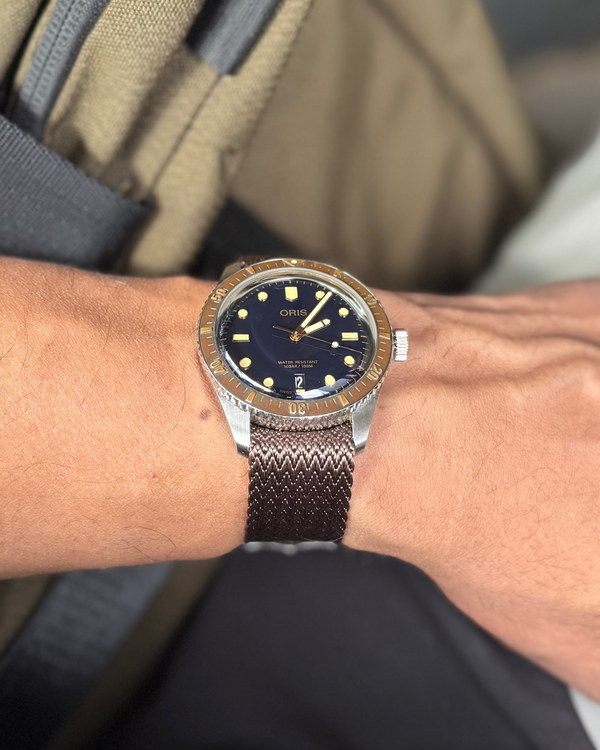
| Pass-through | NATO, single-pass, Zulu, perlon | Field, military-style, travel, heat | Adds height under the case |
Leather straps
Leather is the default for good reason: it is comfortable, ages with you and dresses up or down. Within leather, the finish changes the mood.
- Smooth calf is the classic office strap. Black and dark brown read formal; tan and honey read relaxed.
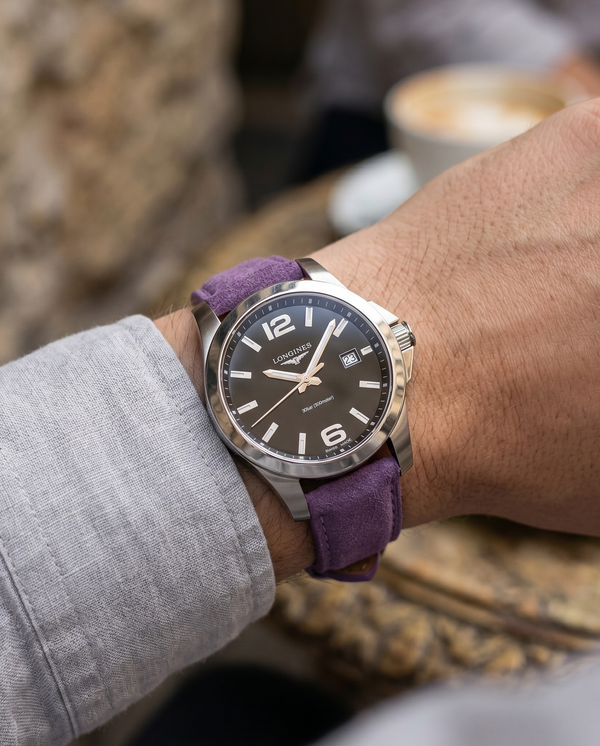
- Suede has a brushed, napped surface. It softens a sharp watch and is lovely on dress and vintage pieces.
- Textured and exotic-grain leathers (croc-grain, lizard-grain, Saffiano-style) add depth without louder colour.
- Rally straps have large round perforations, a nod to 1960s motorsport chronographs.
- Bund straps sit a leather pad under the watch, a style from mid-century German military pilots.
Fabric straps
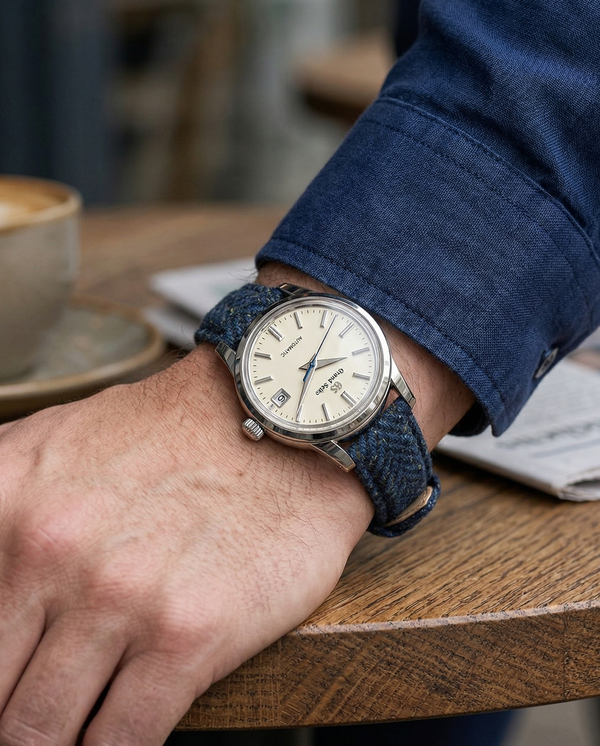
Fabric straps are light, breathable and colourful, which makes them ideal for hot climates. Canvas and sailcloth are tough and slightly stiff. Tweed and khadi add texture and a crafted feel. Fabric usually has a leather or rubber lining to stop fraying and add strength.
Rubber straps
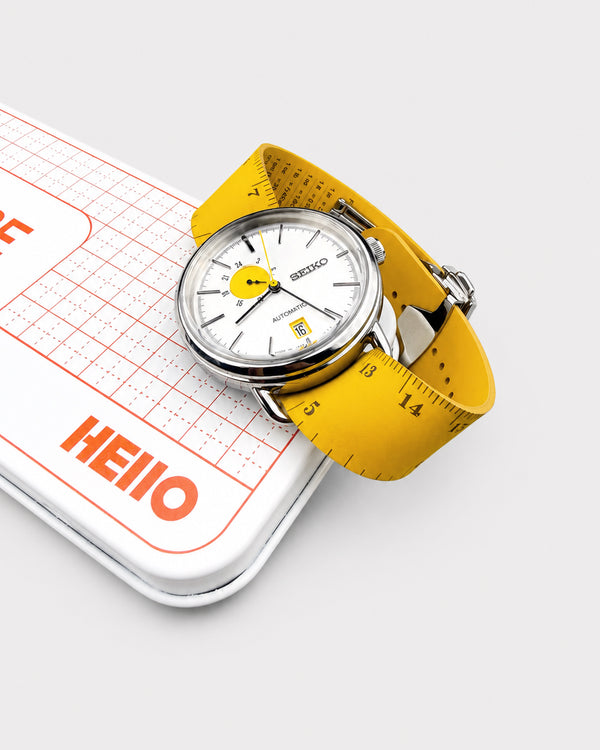
Rubber is the strap for water, sweat and sport. The material matters more than the look. FKM (fluoroelastomer, also sold as FKM rubber or Viton-type rubber) is dense, resists oils and UV and does not pick up lint. Silicone is softer and cheaper but tears more easily and attracts dust. Vintage-style patterns like the tropic (basket-weave) and waffle trace back to 1960s dive watches.
Metal bracelets
A bracelet is a chain of metal links. The link pattern sets the look:
- Oyster-style: three flat, broad links; sporty and tough.
- Jubilee-style: five smaller links; dressier and more fluid. Rolex introduced the original Jubilee on the Datejust in 1945.
- President-style: three rounded links; the original appeared with the Rolex Day-Date in 1956.
- Beads of rice: many small polished links; a mid-century look.
- Milanese mesh: a woven metal mesh, often with a sliding clasp.
Pass-through straps
A pass-through strap is one length of material that threads under the watch and through both spring bars. If one spring bar fails, the watch stays on your wrist. The NATO has an extra flap under the case; the single-pass drops it for a thinner fit. The NATO traces to a 1973 British Ministry of Defence specification; its name comes from the NATO Stock Number the strap was given, not from NATO itself.
How to choose: three questions
- What is the watch's character? Dress watches suit slim leather; tool and dive watches suit rubber, fabric or a bracelet; field watches suit canvas or NATO.
- What does your day look like? Office and evenings point to leather; gym, swimming and monsoon commutes point to rubber.
- What's your climate? In heat and humidity, fabric and rubber stay fresh; leather needs rest days between wears.
Whatever you choose, the width must match your lug width and the taper should suit the case. Both are covered in the next two guides.
Still wondering?
What is the most versatile watch strap?
A dark brown smooth leather strap with a modest taper. It works with dress, field and many sports watches, and from office to evening.
Can I put a leather strap on a dive watch?
Yes, for dry days. Keep a rubber or fabric strap for swimming, because water shortens a leather strap's life.
Are NATO straps comfortable?
Most people find them comfortable and secure, but the double layer raises the watch higher on the wrist. A single-pass strap fixes that.
Which strap is best for hot, humid weather?
Rubber, fabric or a pass-through strap. They breathe or can be washed, and they don't absorb sweat the way leather does.
Do strap brands make straps for any watch?
Any watch with standard lugs and spring bars can take an aftermarket strap. Watches with integrated or proprietary fittings need a strap made for that model.
Keep reading: Lug width, and why 1 mm matters · Strap taper, explained · Spring bars, and quick-release pins · Leather grades, and what "genuine" really means