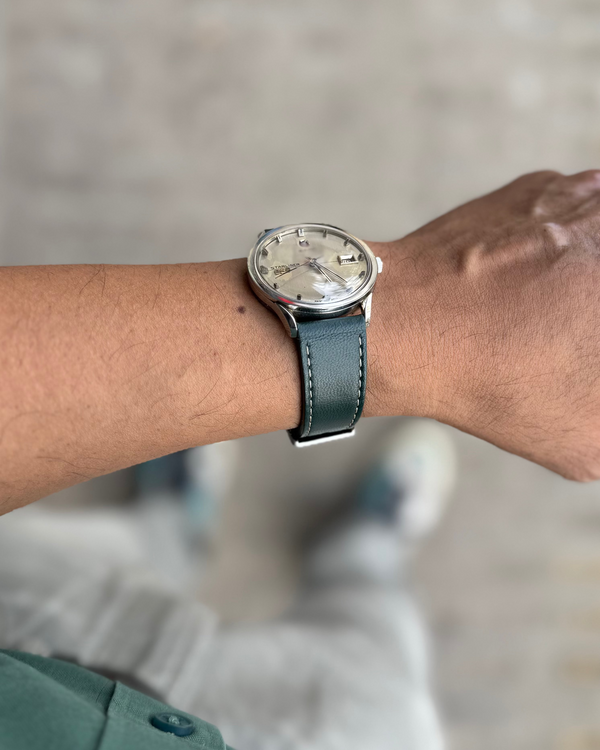
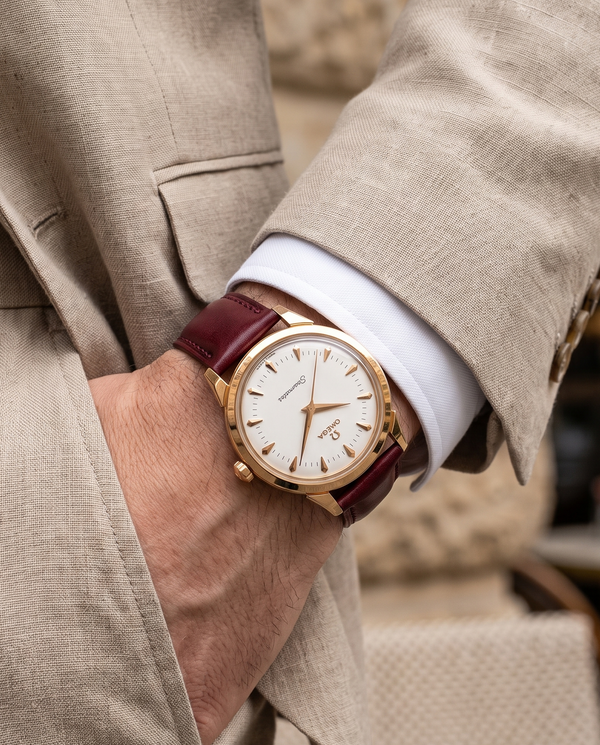
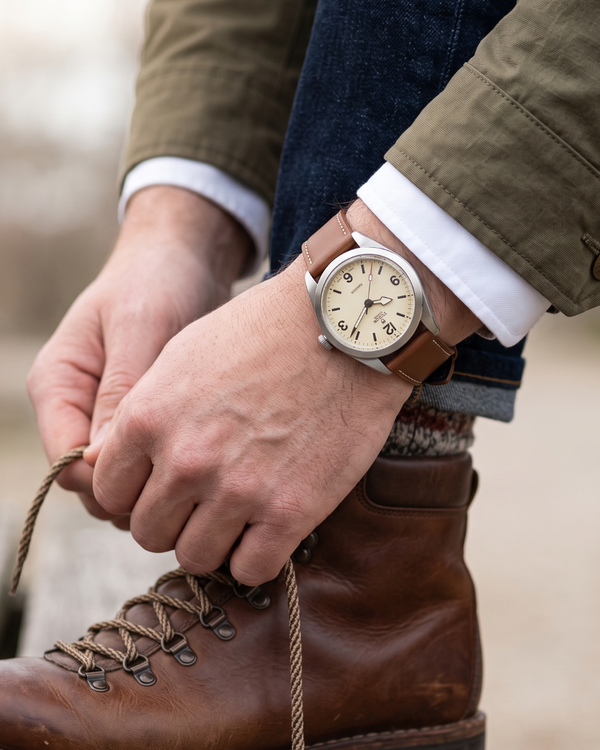
Lug width is the gap between the inside faces of your watch's lugs, measured in millimetres. Your strap must be exactly that wide where it meets the case. Most men's watches use 18, 20 or 22 mm. Measure with a ruler or calipers, or check the maker's specifications.
Key facts
- Lug width is measured between the lugs, not across the case.
- 20 mm is the single most common width on men's watches.
- Odd widths (19, 21 mm) are common on vintage and some modern watches.
- A rough rule: lug width is about half the case diameter (a 40 mm case often has 20 mm lugs).
What the lugs are
Lugs are the four horns that stick out from the top and bottom of the case. A spring bar runs between each pair, and the strap wraps around it. The distance between the lugs in each pair is the lug width.
How to measure lug width
- Check the maker first. Search the model and reference number with "lug width". The spec sheet or the manual usually lists it.
- Use calipers if you have them. Remove the strap, then measure between the inner faces of the lugs. Read to the nearest whole millimetre.
- Use a ruler if you don't. Lay a millimetre ruler across the strap where it meets the case, with the watch face up. Read the gap between the lugs, not the strap width (the old strap may be the wrong size).
- Measure the old strap as a cross-check. If it fit snugly with no gaps, its width at the case end is your lug width.
If you land between two numbers, measure again with calipers. Lug widths are almost always whole millimetres.
Why 1 mm matters
| Strap is… | What happens |
|---|---|
| 1 mm too narrow | Visible gaps beside the strap; the watch shifts sideways; it looks borrowed |
| Exactly right | Strap fills the lugs, sits square and looks made for the watch |
| 1 mm too wide | Strap bunches or won't seat; spring bar tips may not reach the lug holes, which is a real risk of losing the watch |
Never force a wider strap into narrower lugs. The spring bar can sit half in its hole and pop out later.
Common lug widths
| Lug width | Typical watches |
|---|---|
| 12–16 mm | Small dress watches, women's watches, many vintage pieces |
| 18 mm | Dress watches, smaller field watches, many 36–38 mm cases |
| 19 mm | Vintage and vintage-inspired watches |
| 20 mm | The everyday standard for 38–42 mm cases |
| 21 mm | Some vintage and dress chronographs |
| 22 mm | Larger sports and dive watches, 42–45 mm cases |
| 24 mm | Oversized pilot and military-style watches |
These are typical ranges, not rules. Always measure your own watch.
Lug width is only half the fit
Width at the lugs tells you where the strap starts. The taper (how much narrower it gets at the buckle) and the end type (straight or curved) finish the fit. Both have their own guides.
Still wondering?
Is lug width the same as strap width?
At the case end, yes. Further down, the strap usually narrows (taper), so the buckle end is smaller.
Can I use a 20 mm strap on a 21 mm watch?
It will fit, but leaves a visible gap and lets the watch shift. A 21 mm strap is the right choice.
Can I use a 22 mm strap on a 20 mm watch?
No. It won't seat properly and the spring bars may not lock into the lugs.
Where is lug width written on my watch?
Some makers engrave it on the case back or between the lugs; most only list it in the specifications.
Does lug width tell me the case size?
Only roughly. Lug width is often about half the case diameter, but design varies.
Keep reading: Strap taper, explained · Straight end, or curved end? · Strap sizing, and micro-adjustment